
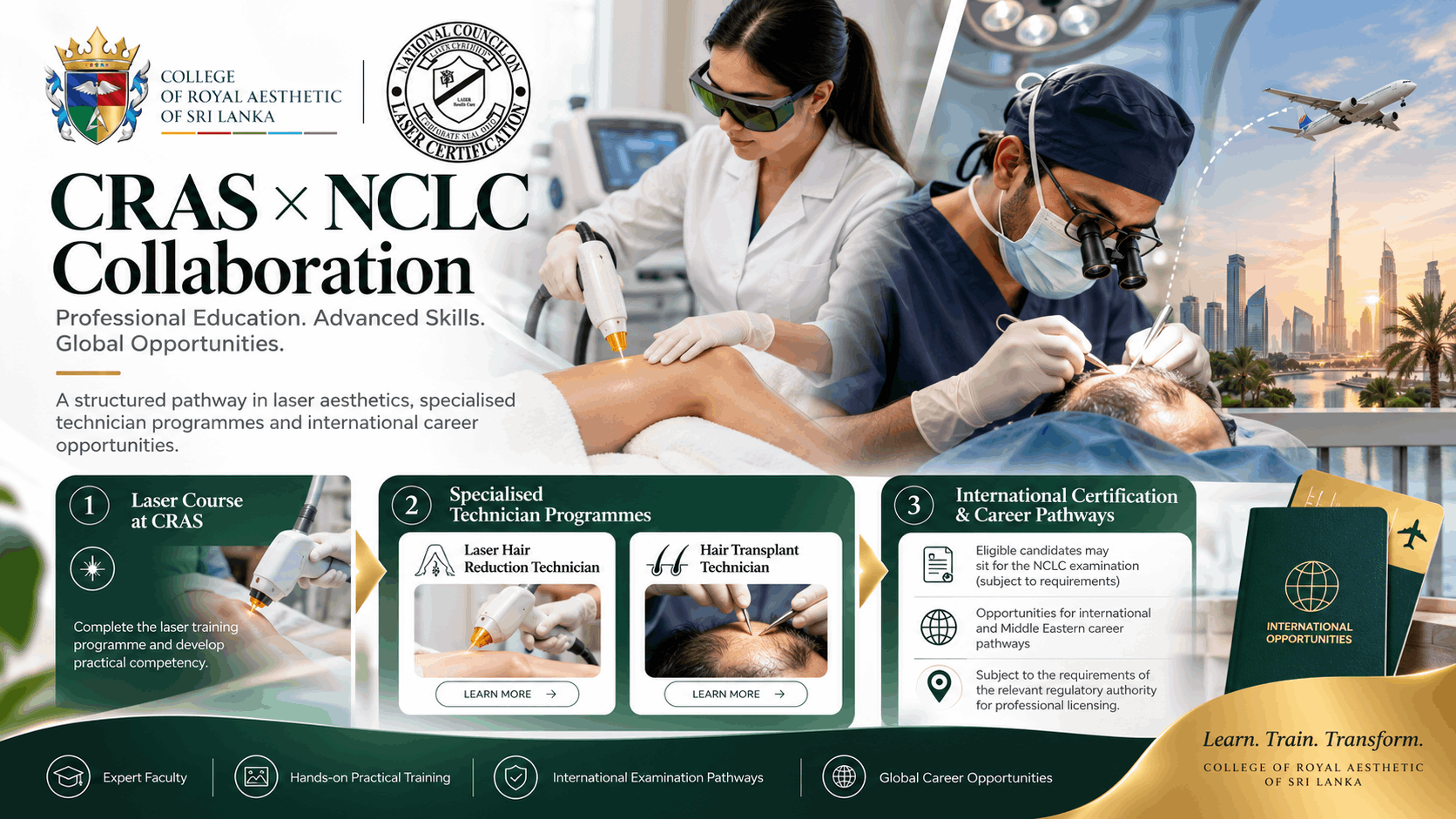
CRAS–NCLC Collaboration: Laser Certification and International Career Pathways
The College of Royal Aesthetic of Sri Lanka (CRAS) is committed to advancing professional education, practical competency and career development in aesthetic and healthcare-related fields. Through its collaboration with the National Council on Laser Certification (NCLC), CRAS provides eligible learners with a structured pathway to pursue specialised laser education and an applicable international certification examination.
For healthcare professionals and other eligible candidates looking to develop their expertise in aesthetic technology, this pathway can be an important step towards further professional development and potential international career opportunities.
A Professional Pathway Beyond Classroom Learning
The aesthetic industry continues to evolve, creating opportunities for trained professionals in laser and light-based technologies, laser hair reduction and hair transplantation. However, professional growth requires more than theoretical knowledge alone. Practical competency, appropriate supervision, recognised qualifications and an understanding of professional regulations are equally important.
CRAS aims to connect professional education with practical learning and competency development. Through its NCLC-related laser certification pathway, eligible students can progress from structured laser training towards the applicable external certification examination, subject to NCLC requirements.
This approach helps learners understand the different stages of professional development while preparing for opportunities within the aesthetic and healthcare sectors.
Understanding the CRAS–NCLC Collaboration
The National Council on Laser Certification (NCLC) provides a separate professional certification and examination pathway for eligible candidates. CRAS provides the relevant educational and practical training components and serves as an NCLC-approved examination centre, subject to the applicable arrangements and requirements.
Students who successfully complete the relevant CRAS laser training meet the applicable educational eligibility requirements to sit for the Certified Laser Operator – Aesthetic (CLO-A) examination.
The pathway generally involves:
-
Professional education: Complete the relevant laser training programme at CRAS.
-
Practical competency: Participate in the prescribed practical training and supervised learning activities.
-
Examination eligibility: Meet the educational requirements applicable to the NCLC examination pathway.
-
External certification assessment: Apply for and sit the applicable NCLC examination in accordance with its requirements.
-
Further professional progression: Where applicable, complete additional practical experience, competency assessments, verification or regulatory requirements.
It is important to understand that CRAS training and NCLC certification are separate processes. Completion of the training programme does not itself mean that a student has passed the NCLC examination or received an NCLC certification credential.
Progression into Specialised Technician Programmes
Laser education can also form part of a broader professional development journey. Following the relevant laser course, eligible candidates may explore additional specialised programmes offered by CRAS, depending on their existing qualifications, professional background and the entry requirements of each programme.
1. Laser Hair Reduction Technician
The Laser Hair Reduction Technician programme is designed to develop specialised knowledge and practical competency in laser and light-based hair reduction.
The pathway may include:
-
Laser and light-based technology fundamentals.
-
Treatment principles and equipment familiarisation.
-
Skin assessment and treatment considerations.
-
Laser safety, contraindications and risk awareness.
-
Supervised practical training or clinical observership, as applicable.
-
Documented clinical case experience where required.
-
Applicable competency assessment and external certification pathways.
-
Guidance on professional registration and licensing requirements where relevant.
Explore the programme: https://cras.lk/laser-hair-reduction-technician
2. Hair Transplant Technician
Hair transplantation is another specialised area within aesthetic and restorative healthcare. The Hair Transplant Technician pathway focuses on developing knowledge and skills relevant to technical support within appropriate hair transplantation settings.
Depending on the programme requirements, the pathway may include:
-
Hair transplantation fundamentals and clinical workflows.
-
Patient preparation and procedural support.
-
Operating-room protocols and infection prevention.
-
Technical assistance and professional responsibilities.
-
Structured clinical observership or supervised practical training.
-
Case logbook and competency documentation.
-
Applicable competency assessment.
-
Guidance on professional recognition and regulatory requirements where relevant.
Explore the programme: https://cras.lk/hair-transplant-technician
Entry into either programme is subject to the relevant admission criteria. Completing a laser course should not be interpreted as automatic admission to every advanced or specialised programme.
Exploring International and Middle Eastern Career Pathways
For many healthcare and aesthetic professionals, international career development is an important long-term goal. Professionals considering opportunities in the United Arab Emirates and other Middle Eastern countries should understand how their existing qualifications, additional training and professional experience relate to the requirements of their intended destination.
The CRAS Professional Licensing Pathways are designed to help eligible candidates understand and prepare for the applicable stages of professional progression. Depending on the country, professional category and intended role, these stages may include:
-
Review of existing academic and professional qualifications.
-
Additional education and supervised practical experience.
-
Competency assessments or external examinations.
-
Primary-source verification, including DataFlow where applicable.
-
Professional registration with the relevant authority, where required.
-
A regulatory examination or licensing application, where applicable.
-
Compliance with employer, facility, supervision and scope-of-practice requirements.
These requirements differ between countries and professional categories. A qualification or certification that is relevant to one professional role may not meet the requirements for another.
An important clarification: NCLC certification and a healthcare licence issued by a Middle Eastern regulator are not the same credential. Completing a CRAS course or an NCLC examination does not automatically grant a UAE, Middle Eastern or other international medical licence. Final eligibility and licensing decisions rest with the relevant regulatory authority.
Prospective students should therefore identify their intended country and professional role before choosing a pathway. CRAS can provide guidance on its educational and training programmes, while candidates should verify the current licensing requirements directly with the appropriate regulator.
Why Choose CRAS for Professional Development?
The College of Royal Aesthetic of Sri Lanka focuses on structured education, practical learning and continuing professional development in aesthetic and healthcare-related fields.
Through its specialised programmes and professional pathway guidance, CRAS aims to help eligible learners:
-
Develop knowledge in specialised aesthetic technologies.
-
Strengthen practical skills through applicable supervised training.
-
Understand the relationship between qualifications, competency assessments and external certification.
-
Explore further training in laser hair reduction and hair transplantation.
-
Prepare for the documentation and regulatory processes that may apply to international career plans.
-
Make informed decisions about their professional development.
The right pathway depends on more than the name of a course. Existing qualifications, professional experience, career objectives and the requirements of the destination country should all be considered.
Start Your Professional Development Journey with CRAS
Whether you are a nursing professional, an eligible aesthetic practitioner or another candidate who meets the relevant entry requirements, specialised training can help you build knowledge and explore new areas of professional development.
Through its NCLC-related laser certification pathway and specialised programmes in laser hair reduction and hair transplantation, CRAS offers opportunities for eligible learners to develop their competencies and understand potential next steps in their careers.
Explore the programmes:
-
Laser Hair Reduction Technician: https://cras.lk/laser-hair-reduction-technician
-
Hair Transplant Technician: https://cras.lk/hair-transplant-technician
For information about eligibility, course details and the appropriate professional pathway, contact the College of Royal Aesthetic of Sri Lanka.
College of Royal Aesthetic of Sri Lanka (CRAS)
Website: https://cras.lk
Email: info@cras.lk
Learn. Train. Transform.
Regulatory notice: Course completion, eligibility for an external examination, certification and professional licensing are distinct stages. Admission, examination eligibility, certification and authorisation to practise are subject to the applicable requirements of the relevant institution and regulatory authority. No course or certification guarantees international licensing or employment.
.Recent Events
-
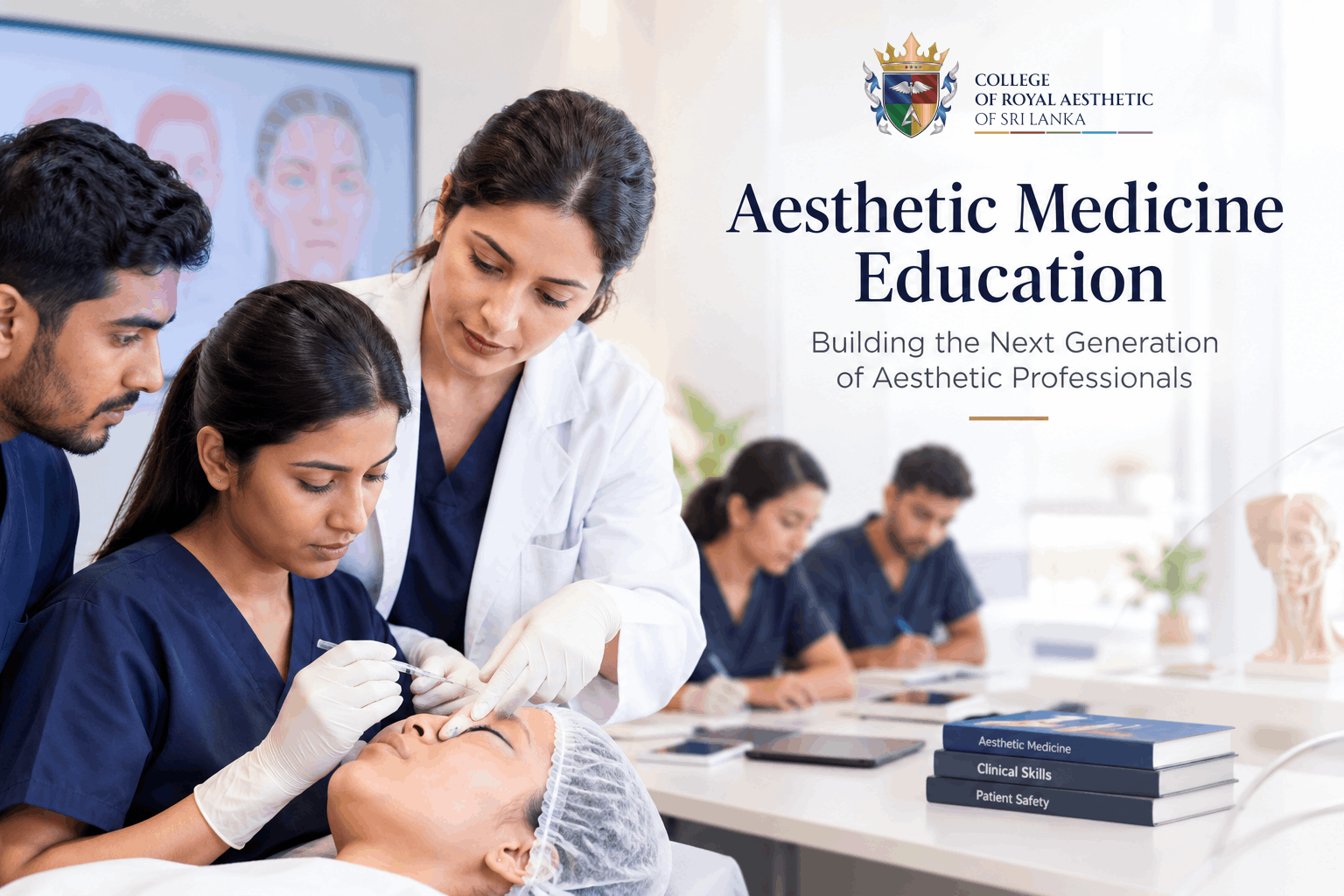
Aesthetic Medicine: Where Science, Skills and...
12 Sep, 2026
-
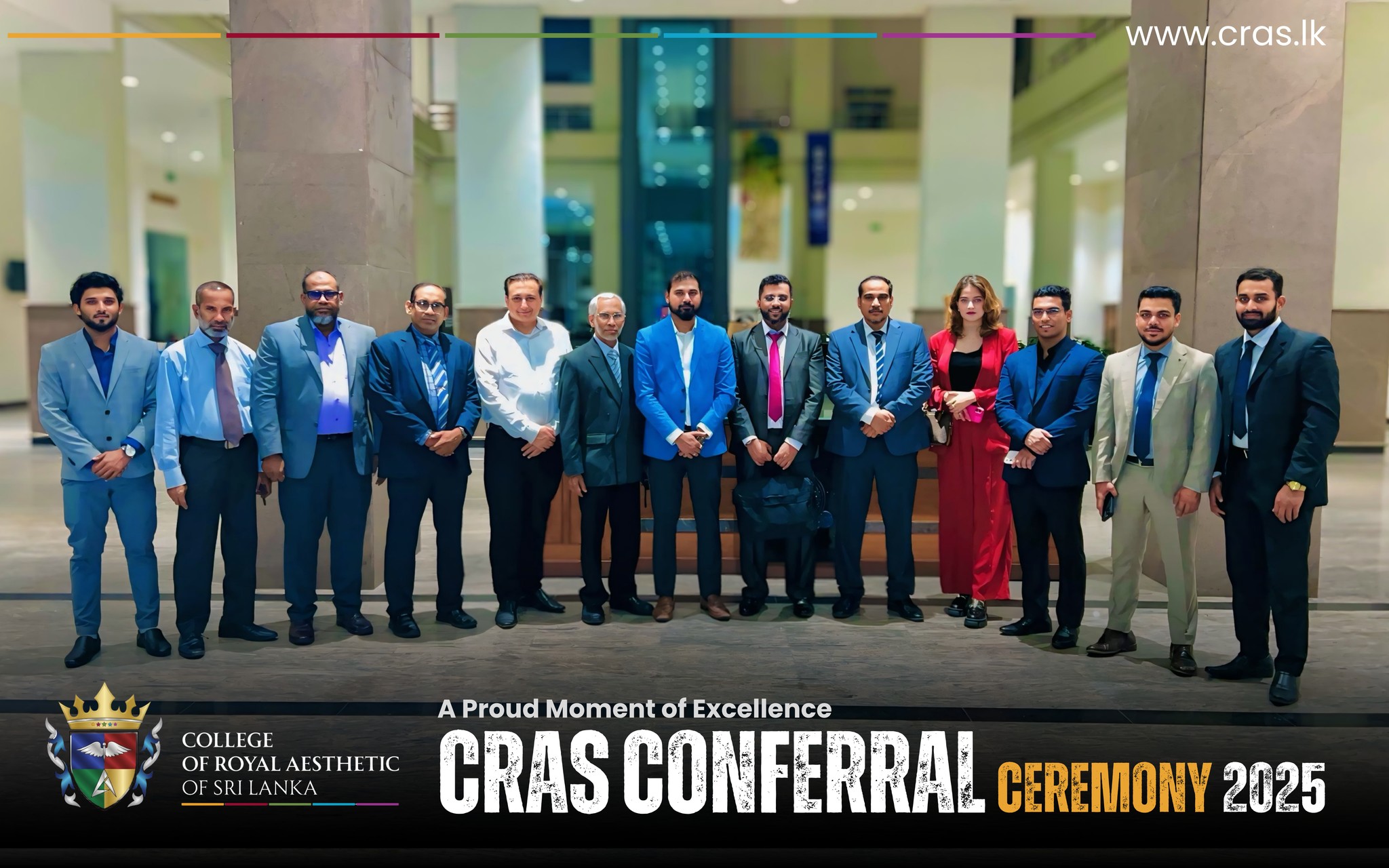
CRAS Conferral Ceremony Celebrates Excellence...
19 May, 2026